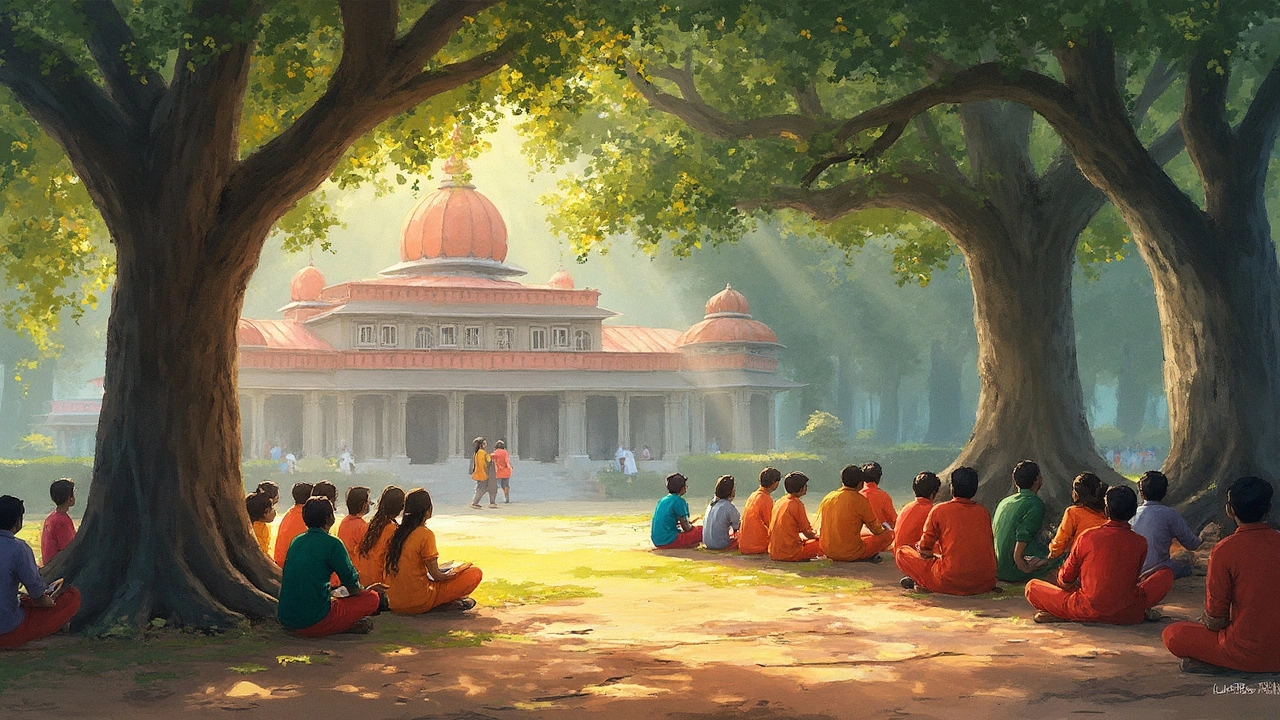
Santiniketan: India's Quiet Heart of Art, Culture, and Learning
When you think of India’s cultural landmarks, you might picture the Taj Mahal or the temples of Varanasi. But Santiniketan, a serene town in West Bengal founded by Rabindranath Tagore as a center for holistic education and artistic expression. Also known as the abode of peace, it’s where learning didn’t happen in lecture halls—it happened under banyan trees, in open-air classrooms, and through music, dance, and craft. This isn’t just a school. It’s a living philosophy. Tagore built Santiniketan to break free from rigid colonial education. He wanted students to grow with nature, not against it. He believed art wasn’t separate from life—it was the thread that held it all together.
At the heart of Santiniketan is Visva-Bharati University, a global institution established by Tagore in 1921, now a central university funded by the Indian government. It’s not just a college—it’s a movement. Students here learn weaving from local artisans, compose poetry under the sky, and study ancient texts alongside modern ideas. The campus doesn’t feel like a campus. It feels like a village that learned to think. And that’s why it draws artists, thinkers, and travelers from across the world—not for fame, but for quiet inspiration. You won’t find billboards or neon lights here. You’ll find mud walls painted with folk art, students playing the sitar at dawn, and elders teaching how to make natural dyes from turmeric and indigo. This is the real India—not the one you see in travel brochures, but the one that still breathes through tradition.
Tagore’s legacy isn’t locked in museums. It’s alive in the way people here still celebrate Poush Mela, the annual fair that turns the town into a festival of music, crafts, and food. It’s in the way local weavers still use handlooms passed down for generations. And it’s in the way visitors leave not with souvenirs, but with a new way of seeing the world. Santiniketan doesn’t shout. It whispers. And if you listen, it tells you what education, art, and peace can look like when they’re not for sale.
What you’ll find in the posts below isn’t a list of tourist spots. It’s a collection of real stories—from the quiet moments at the university’s open-air classrooms to the deep cultural roots that still shape daily life here. You’ll read about how Santiniketan connects to India’s broader heritage, why it stands apart from the usual temple-and-palace circuits, and how its values still echo in today’s India. This isn’t a place you visit. It’s a place that changes you.